
Motor design requires balancing multiple material components. This guide focuses on the three most commonly used permanent magnets in motors: Neodymium (NdFeB), Samarium Cobalt (SmCo), and Ferrite/Ceramic magnets.
Neodymium Magnets
Neodymium magnets are the strongest magnets available, providing maximum magnetic field in motor circuits with multiple material variations suited to different temperature and environmental requirements.
Advantages
- High induction (Br); grades from 30 to 55 MGOe
- Good resistance to demagnetization (Hci)
- High flux density per square centimeter (MGOe)
- Correctly selected material will last indefinitely
- Can reduce size and weight of rotor and stator
- Large selection of material grades
Disadvantages
- Can oxidize if not coated
- Lower working temperature than some other materials
Summary: Neodymium magnets work well in applications that require high stability and high induction over a lower operating temperature range.
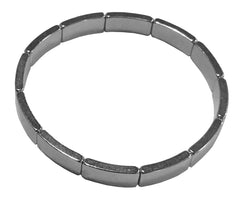
Samarium Cobalt (SmCo) Magnets
SmCo magnets rank second only to neodymium in strength and come in material variations known as SmCo 1-5 and SmCo 2-17.
Advantages
- High induction (Br); grades 16 to 32 MGOe
- Excellent resistance to demagnetization (Hci) up to 350 °C
- Excellent resistance to oxidation without coating
Disadvantages
- High cost
- More brittle and easier to chip or break
Summary: Samarium cobalt magnets work well in high-temperature applications that require strong resistance to demagnetization.
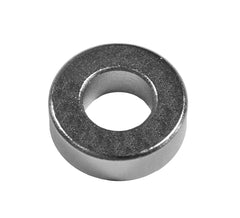
Ferrite / Ceramic Magnets
These magnets see the widest motor application due to lower cost, though this affordability involves certain trade-offs.
Advantages
- Low cost
- Excellent resistance to oxidation
- Large abundance of raw materials
Disadvantages
- Low induction (Br); grades 1 to 10 MGOe
- Usually requires a mold
- May deteriorate in a magnetic field over time
- Lower resistance to demagnetization
Summary: Ceramic magnets work well in applications where cost is a greater concern than size and weight.
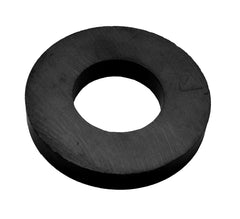
Picking the Correct Magnet
Each motor design is very different, and working with an experienced magnet professional is important. Magnets can be manufactured in numerous shapes and virtually any size. Common stock options for motor applications include arc magnets, square magnets, radial rings, and rectangle magnets.
For evaluation samples and stock motor magnets, see our eCommerce division SuperMagnetMan. For custom motor magnet specifications and quantities, our engineering team can support material selection, geometry, and production transition.