
In materials mechanics, “soft” means that a material will yield readily to touch or pressure. However, when discussing soft magnetic materials, the term refers to magnetic properties rather than mechanical characteristics — specifically, how readily a material’s magnetism responds to external magnetic fields.
Understanding Soft Magnets
A nail demonstrates soft magnetic behavior. When a magnet’s North pole approaches a nail’s head, a South pole appears at that location, causing attraction. Reversing the magnet creates the opposite polarity at the nail’s head, yet attraction persists because the nail will still be attracted to the magnet, rather than be repelled away as the result of like poles repelling each other. The nail’s polarity changes obediently with the external field.
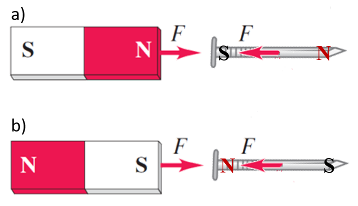
In contrast, permanent or hard magnets resist external magnetic field influence and maintain stable polarity. When a soft magnet stands alone without external influence, its poles will break down into many much tinier poles named as magnetic domains; the polarity of each domain is antiparallel or perpendicular to its neighbors.
Market Significance and Applications
Despite their inability to maintain polarity independently, soft magnetic materials represent substantial commercial value. In 2016, the market size for hard magnetic materials was estimated to be around $14 billion, whereas that for soft magnetic materials was around $18 billion.
Soft magnetic materials serve critical functions across numerous applications:
- Machines converting between electrical and mechanical energy (motors and generators)
- Devices converting electric current waveforms (transformers, inverters, converters, inductors, filters)
- Electromagnets and devices exploiting magnetic attractive force
- Consumer products: hair dryers, vacuum cleaners, washing machines, air conditioners, wireless chargers, computer power supplies, refrigerator door magnets
Magnetic Field Enhancement
The principle underlying these applications centers on soft magnetic materials’ interaction with magnetic fields, typically produced by electrical current. Just because soft magnetic materials are ready to respond to external fields, the magnetic flux would prefer to “run” through a soft magnet instead of through non-magnetic mediums. Moreover, soft magnetic materials not only respond to external magnetic field readily, but they can also enhance the magnetic field (flux density) intensely. They function as magnetic field conductors and flux multipliers.
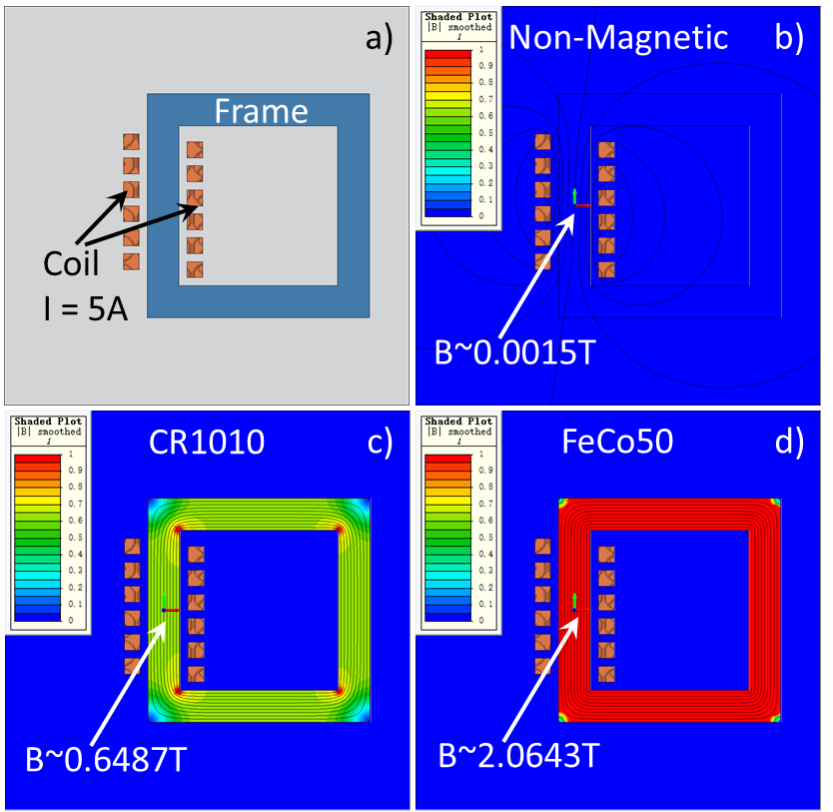
A practical example illustrates this enhancement effect. A 6-turn coil carrying 5 A (30 Ampere-Turns) generates different results depending on frame material:
Next Steps
Understanding these fundamentals provides the foundation for deeper exploration. The series continues in Part 2 with examination of Key Performance Indicators (KPIs) that define how soft magnetic materials perform in real-world applications.