
Maximum strength
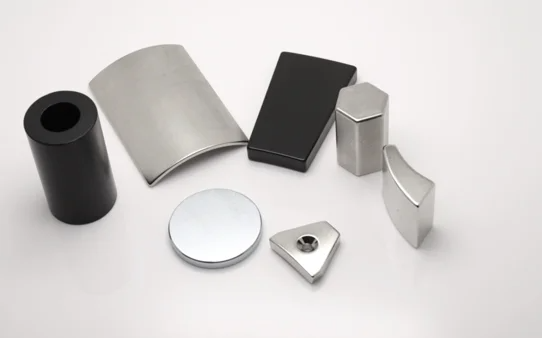
Sintered NdFeB
Highest energy density of any commercial magnet. Default for motors, sensors, and high-torque applications below 220°C.
Materials & specifications
Property data for the magnet families we manufacture. Pick a family below to see grade-by-grade values for residual induction, coercivity, energy product, and operating temperature.
The highest energy density permanent magnets in commercial production. Selected when raw magnetic strength matters most: motors, sensors, hard drives, MRI components, and high-torque actuators.
Grades are organized by temperature class. The base grade (N35–N56) covers room-temperature applications. Suffix letters extend operating temperature: M to 100°C, H to 120°C, SH to 150°C, UH to 180°C, EH to 200°C, and AH to 220°C.
NdFeB is sensitive to corrosion and is typically supplied with a Ni-Cu-Ni, epoxy, or other protective coating. See the Coatings & Platings reference.
Combined PDF with every grade, BH curves, and temperature coefficients in one document.
Download PDF| Grade | Br T | HcB kA/m | HcJ kA/m | (BH)max kJ/m³ | Tmax °C |
|---|---|---|---|---|---|
| N35 | 1.17–1.22 | ≥868 | ≥955 | 263–287 | 80 |
| N38 | 1.22–1.26 | ≥899 | ≥955 | 287–310 | 80 |
| N40 | 1.26–1.29 | ≥907 | ≥955 | 302–326 | 80 |
| N42 | 1.29–1.33 | ≥915 | ≥955 | 318–342 | 80 |
| N45 | 1.33–1.37 | ≥915 | ≥955 | 342–366 | 80 |
| N48 | 1.37–1.40 | ≥876 | ≥955 | 358–390 | 80 |
| N50 | 1.39–1.42 | ≥836 | ≥955 | 374–406 | 80 |
| N52 | 1.42–1.45 | ≥836 | ≥955 | 382–414 | 80 |
| N54 | 1.44–1.47 | ≥796 | ≥875 | 398–422 | 60 |
| N56 | 1.46–1.50 | ≥796 | ≥875 | 406–438 | 60 |
| N35M | 1.17–1.22 | ≥868 | ≥1114 | 263–287 | 100 |
| N38M | 1.22–1.26 | ≥899 | ≥1114 | 287–310 | 100 |
| N40M | 1.26–1.29 | ≥923 | ≥1114 | 302–326 | 100 |
| N42M | 1.29–1.33 | ≥955 | ≥1114 | 318–342 | 100 |
| N45M | 1.33–1.37 | ≥995 | ≥1114 | 342–366 | 100 |
| N48M | 1.37–1.40 | ≥1035 | ≥1114 | 358–390 | 100 |
| N50M | 1.39–1.42 | ≥1035 | ≥1114 | 374–406 | 100 |
| N52M | 1.42–1.45 | ≥1035 | ≥1114 | 382–414 | 100 |
| N54M | 1.44–1.47 | ≥1035 | ≥1114 | 398–422 | 100 |
| N35H | 1.17–1.22 | ≥868 | ≥1353 | 263–287 | 120 |
| N38H | 1.22–1.26 | ≥899 | ≥1353 | 287–310 | 120 |
| N40H | 1.26–1.29 | ≥923 | ≥1353 | 302–326 | 120 |
| N42H | 1.29–1.33 | ≥955 | ≥1353 | 318–342 | 120 |
| N45H | 1.33–1.37 | ≥971 | ≥1353 | 342–366 | 120 |
| N48H | 1.37–1.40 | ≥995 | ≥1353 | 358–390 | 120 |
| N50H | 1.39–1.42 | ≥1035 | ≥1353 | 374–406 | 120 |
| N52H | 1.42–1.45 | ≥1035 | ≥1353 | 382–414 | 120 |
| N54H | 1.44–1.47 | ≥1035 | ≥1353 | 398–422 | 120 |
| N35SH | 1.17–1.22 | ≥876 | ≥1592 | 263–287 | 150 |
| N38SH | 1.22–1.26 | ≥907 | ≥1592 | 287–310 | 150 |
| N40SH | 1.26–1.29 | ≥939 | ≥1592 | 302–326 | 150 |
| N42SH | 1.29–1.33 | ≥955 | ≥1592 | 318–342 | 150 |
| N45SH | 1.33–1.37 | ≥995 | ≥1592 | 342–366 | 150 |
| N48SH | 1.37–1.40 | ≥995 | ≥1592 | 358–390 | 150 |
| N50SH | 1.39–1.42 | ≥1035 | ≥1592 | 374–406 | 150 |
| N52SH | 1.42–1.45 | ≥1035 | ≥1512 | 382–414 | 150 |
| N54SH | 1.44–1.47 | ≥1035 | ≥1592 | 398–422 | 150 |
| N35UH | 1.17–1.22 | ≥860 | ≥1990 | 263–287 | 180 |
| N38UH | 1.22–1.26 | ≥876 | ≥1990 | 287–310 | 180 |
| N40UH | 1.26–1.29 | ≥915 | ≥1990 | 302–326 | 180 |
| N42UH | 1.29–1.33 | ≥955 | ≥1990 | 318–342 | 180 |
| N45UH | 1.33–1.37 | ≥995 | ≥1990 | 342–366 | 180 |
| N48UH | 1.37–1.40 | ≥995 | ≥1910 | 358–390 | 180 |
| N50UH | 1.39–1.42 | ≥1035 | ≥1990 | 374–406 | 180 |
| N52UH | 1.42–1.45 | ≥1058 | ≥1990 | 382–414 | 180 |
| N35EH | 1.17–1.22 | ≥860 | ≥2388 | 263–287 | 200 |
| N38EH | 1.22–1.26 | ≥876 | ≥2388 | 287–310 | 200 |
| N40EH | 1.26–1.29 | ≥915 | ≥2388 | 302–326 | 200 |
| N42EH | 1.29–1.33 | ≥955 | ≥2388 | 318–342 | 200 |
| N45EH | 1.33–1.37 | ≥995 | ≥2308 | 342–366 | 200 |
| N48EH | 1.37–1.40 | ≥995 | ≥2388 | 358–390 | 200 |
| N50EH | 1.39–1.42 | ≥1035 | ≥2388 | 374–406 | 200 |
| N35AH | 1.17–1.22 | ≥860 | ≥2786 | 263–287 | 220 |
| N38AH | 1.22–1.26 | ≥876 | ≥2786 | 287–310 | 220 |
| N40AH | 1.26–1.29 | ≥915 | ≥2706 | 302–326 | 220 |
| N42AH | 1.29–1.33 | ≥955 | ≥2786 | 318–342 | 220 |
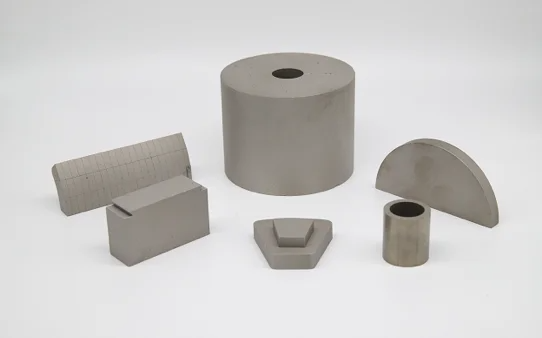
The right answer when temperature, corrosion, or radiation rules out NdFeB. SmCo holds its magnetization at elevated temperatures and resists oxidation without coatings.
Common in aerospace, downhole oil & gas tools, military, and high-reliability sensor applications. Two main families: SmCo5 (1:5) and Sm2Co17 (2:17), with the latter offering higher energy density and temperature stability.
SmCo is brittle and harder to machine than NdFeB. Designs typically account for chamfered edges and tighter handling specs.
Combined PDF with every grade and the BH curves for both 1:5 and 2:17 families.
Download PDF| Grade | Br T | HcB kA/m | HcJ kA/m | (BH)max kJ/m³ | Tmax °C | α(Br) %/°C |
|---|---|---|---|---|---|---|
| SmCo-20 | 0.89–0.93 | 684–732 | ≥1830 | 150–167 | 250 | −0.045 |
| SmCo-22 | 0.92–0.96 | 710–756 | ≥1830 | 167–183 | 250 | −0.045 |
| SmCo-24 | 0.96–1.00 | 740–788 | ≥1830 | 183–199 | 250 | −0.045 |
| SmCo-30L | 1.08–1.15 | 541–796 | 636–955 | 220–240 | 250 | −0.035 |
| SmCo-32L | 1.10–1.15 | 541–812 | 636–955 | 230–255 | 250 | −0.035 |
| SmCo-30M | 1.08–1.10 | 676–835 | 955–1433 | 220–240 | 300 | −0.035 |
| SmCo-32M | 1.10–1.13 | 676–852 | 955–1433 | 230–255 | 300 | −0.035 |
| SmCo-28 | 1.03–1.08 | 756–812 | ≥1433 | 207–220 | 300 | −0.035 |
| SmCo-30 | 1.08–1.10 | 788–835 | ≥1433 | 220–240 | 300 | −0.035 |
| SmCo-32 | 1.10–1.13 | 812–860 | ≥1433 | 230–255 | 300 | −0.035 |
| SmCo-28H | 1.03–1.08 | 756–812 | ≥1990 | 207–220 | 350 | −0.035 |
| SmCo-30H | 1.08–1.10 | 788–835 | ≥1990 | 220–240 | 350 | −0.035 |
| SmCo-32H | 1.10–1.13 | 812–860 | ≥1990 | 230–255 | 350 | −0.035 |
| SmCo-33H | 1.13–1.15 | 830–880 | ≥1990 | 246–262 | 350 | −0.039 |
| SmCo-35H | 1.16–1.20 | 852–899 | ≥1990 | 255–271 | 300 | −0.039 |
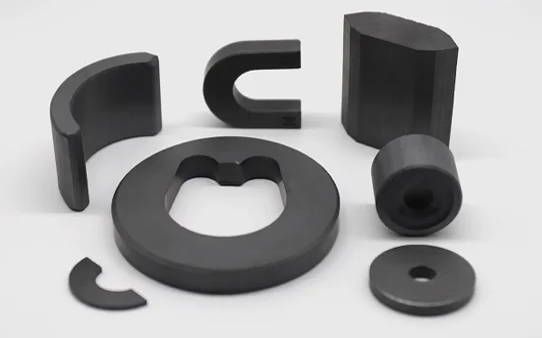
The most cost-effective permanent magnet on the market. Inherent corrosion resistance, mechanical hardness, and a long history of use across motors, speakers, holding magnets, and consumer products.
Lower energy density than rare-earth families, but the price-per-pound advantage is significant for high-volume programs that don't need maximum performance. Strontium-based grades dominate; barium-based variants exist but are less common today.
| Grade | Br mT | Br kGs | HcB kA/m | HcJ kA/m | (BH)max kJ/m³ | (BH)max MGOe | Tmax °C |
|---|---|---|---|---|---|---|---|
| XM10T | 200–235 | 2.0–2.35 | 128–160 | 210–280 | 6.4–9.6 | 0.8–1.2 | 250 |
| XM25 | 360–400 | 3.6–4.0 | 135–170 | 140–200 | 22.5–28.0 | 2.8–3.5 | 250 |
| XM30 | 380–400 | 3.8–4.0 | 175–210 | 180–220 | 26.0–30.0 | 3.3–3.8 | 250 |
| XM33 | 410–430 | 4.1–4.3 | 220–250 | 225–255 | 31.5–35.0 | 4.0–4.4 | 250 |
| XM35 | 400–440 | 4.0–4.4 | 176–224 | 180–230 | 30.3–33.4 | 3.8–4.2 | 250 |
| XM30BH | 380–400 | 3.8–4.0 | 223–235 | 231–245 | 27.0–30.0 | 3.4–3.8 | 250 |
| XM33H | 410–430 | 4.1–4.3 | 250–270 | 250–275 | 31.5–35.0 | 4.0–4.4 | 250 |
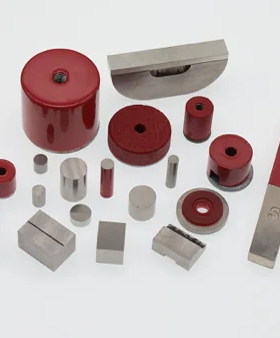
The first commercial permanent magnet, and still unmatched for high-temperature stability. Alnico holds magnetization above 500°C, where rare-earth materials fall apart.
Common in instrumentation, sensor probes, guitar pickups, holding fixtures, and any application where temperature swing or thermal stability matters more than absolute strength.
Cast and sintered grades exist (the FLNG prefix denotes flexible/sintered variants). Alnico is mechanically robust and machinable but easily demagnetized by external fields, so circuit design matters.
Combined PDF for cast (LNG/LNGT) and sintered (FLNG/FLNGT) Alnico families.
Download PDF| Grade | Br T | HcB kA/m | HcJ kA/m | (BH)max kJ/m³ | Tmax °C | α(Br) %/°C |
|---|---|---|---|---|---|---|
| LN10 | 0.65 | 38 | 40 | 10 | 450 | −0.035 |
| LNG12 | 0.75 | 45 | 46 | 12 | 450 | −0.030 |
| LNGT18 | 0.55 | 90 | 97 | 18 | 550 | −0.025 |
| LNG34 | 1.10 | 50 | 52 | 34 | 525 | −0.020 |
| LNG37 | 1.18 | 49 | 51 | 37 | 525 | −0.020 |
| LNG40 | 1.20 | 50 | 52 | 40 | 525 | −0.020 |
| LNG44 | 1.25 | 52 | 54 | 44 | 525 | −0.020 |
| LNGT28 | 1.05 | 56 | 58 | 28 | 525 | −0.020 |
| LNG52 | 1.30 | 56 | 58 | 52 | 525 | −0.020 |
| LNG60 | 1.35 | 58 | 60 | 60 | 525 | −0.020 |
| LNGT34 | 0.80 | 104 | 106 | 34 | 550 | −0.025 |
| LNGT38 | 0.80 | 110 | 112 | 38 | 550 | −0.025 |
| LNGT40 | 0.85 | 115 | 117 | 40 | 550 | −0.025 |
| LNGT44 | 0.90 | 115 | 117 | 44 | 550 | −0.025 |
| LNGT36J | 0.72 | 150 | 144 | 36 | 550 | −0.025 |
| LNGT40J | 0.75 | 144 | 159 | 40 | 550 | −0.025 |
| LNGT60 | 1.00 | 110 | 112 | 60 | 550 | −0.025 |
| LNGT72 | 1.05 | 115 | 117 | 72 | 550 | −0.025 |
| LNGT80 | 1.08 | 120 | 122 | 80 | 550 | −0.025 |
| LNGT96 | 1.10 | 128 | 122 | 96 | 550 | −0.025 |
| FLNG10 | 0.65 | 40 | 42 | 10 | 450 | −0.035 |
| FLNG12 | 0.75 | 45 | 46 | 12 | 450 | −0.035 |
| FLNGT18 | 0.60 | 95 | 98 | 18 | 550 | −0.025 |
| FLNGT20 | 0.62 | 100 | 105 | 20 | 550 | −0.025 |
| FLNG34 | 1.10 | 50 | 52 | 34 | 525 | −0.020 |
| FLNG37 | 1.18 | 49 | 51 | 37 | 525 | −0.020 |
| FLNGT28 | 1.05 | 56 | 58 | 28 | 525 | −0.020 |
| FLNGT36J | 0.72 | 150 | 144 | 36 | 550 | −0.025 |
| FLNGT38 | 0.80 | 104 | 106 | 38 | 550 | −0.025 |
| FLNGT40J | 0.75 | 144 | 159 | 40 | 550 | −0.025 |
| FLNGT44 | 0.90 | 115 | 117 | 44 | 550 | −0.025 |
| FLNGT48 | 0.92 | 115 | 117 | 48 | 550 | −0.025 |
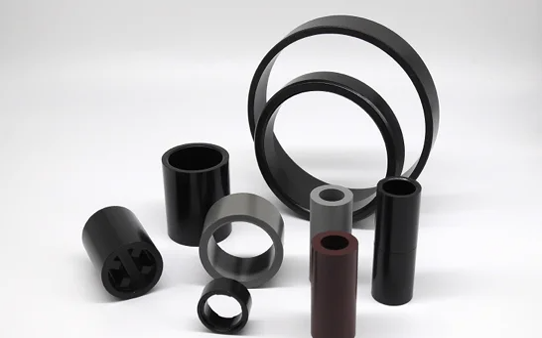
Magnet powder mixed with a polymer binder, then compression- or injection-molded to net shape. Lower performance per volume than fully sintered magnets, but enables intricate geometries, multi-pole magnetization patterns, and integration with plastic components in a single shot.
Compression molding uses an epoxy binder for higher loading and better magnetic performance. Injection molding uses thermoplastics (PA, PPS) for better mechanical properties and complex shapes including overmolding.
Combined PDF covering compression and injection molded NdFeB and ferrite grades.
Download PDF| Grade | Br T | HcB kA/m | HcJ kA/m | (BH)max kJ/m³ | Tmax °C |
|---|---|---|---|---|---|
| KBM-2 | 0.30–0.40 | 160–240 | 480–640 | 16–24 | ≤120 |
| KBM-4 | 0.40–0.50 | 240–320 | 560–720 | 32–44 | ≤120 |
| KBM-6 | 0.50–0.60 | 320–400 | 480–640 | 48–60 | ≤120 |
| KBM-8 | 0.60–0.68 | 360–440 | 640–800 | 64–72 | ≤150 |
| KBM-8H | 0.60–0.65 | 400–480 | 1120–1280 | 60–68 | ≤160 |
| KBM-8L | 0.65–0.68 | 400–480 | 900–1120 | 64–72 | ≤160 |
| KBM-9 | 0.60–0.68 | 400–480 | 640–800 | 68–72 | ≤150 |
| KBM-10 | 0.68–0.73 | 400–480 | 640–800 | 76–84 | ≤150 |
| KBM-12 | 0.71–0.75 | 440–520 | 720–800 | 84–96 | ≤150 |
| KBM-12L | 0.72–0.76 | 400–480 | 480–640 | 84–96 | ≤140 |
| Grade | Br T | HcB kA/m | HcJ kA/m | (BH)max kJ/m³ | Tmax °C |
|---|---|---|---|---|---|
| KBI-3 | 0.20–0.30 | 160–240 | 480–640 | 12–24 | ≤100 |
| KBI-4 | 0.35–0.45 | 240–320 | 560–720 | 24–36 | ≤120 |
| KBI-5 | 0.45–0.52 | 320–360 | 560–720 | 36–44 | ≤120 |
| KBI-5H (PPS) | 0.48–0.52 | 400–480 | 880–1040 | 36–44 | ≤150 |
| KBI-6 | 0.50–0.55 | 320–440 | 640–800 | 44–52 | ≤120 |
| KBI-7 | 0.54–0.64 | 320–400 | 640–800 | 52–60 | ≤120 |
| KBI-8 | 0.64–0.74 | 400–480 | 640–800 | 68–76 | ≤120 |
| Grade | Br T | HcB kA/m | HcJ kA/m | (BH)max kJ/m³ | Tmax °C |
|---|---|---|---|---|---|
| KBI-F1.5 | 0.22–0.24 | 160–167 | 231–240 | 11.6–12.4 | ≤120 |
| KBI-F1.9 | 0.27–0.29 | 180–186 | 216–228 | 14.8–15.6 | ≤120 |
| KBI-F2.0 | 0.28–0.29 | 184–200 | 216–246 | 15.6–16.4 | ≤120 |
| KBI-F2.1 | 0.28–0.29 | 190–204 | 224–249 | 16.4–17.2 | ≤120 |
| KBI-F1.7 (PPS) | 0.25–0.26 | 167–175 | 208–216 | 13.6–14.0 | ≤160 |
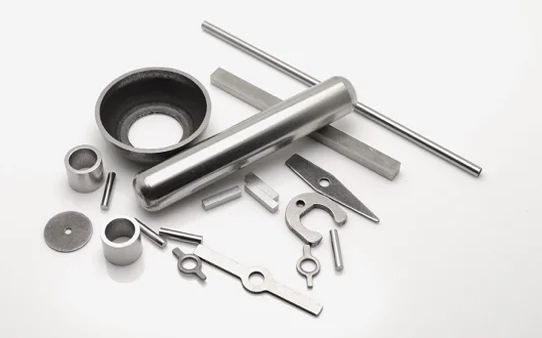
An iron-chromium-cobalt alloy with a property profile similar to Alnico, but mechanically ductile and machinable in the soft state. Hardened after machining to lock in magnetic properties.
Used where geometric complexity, machining, or thread-cutting on a magnet body is required. Common in hysteresis motors, sensors, and relay components.
Combined PDF with all FeCrCo grades, BH curves, and machining notes.
Download PDFSelection guide
A quick orientation for picking a family. The right answer depends on operating temperature, environment, geometry, and budget.
Maximum strength
Highest energy density of any commercial magnet. Default for motors, sensors, and high-torque applications below 220°C.
High temperature, harsh environments
Holds magnetization to 350°C, resists corrosion without coatings, and tolerates radiation. The aerospace and downhole choice.
Cost-driven, high volume
Inexpensive, corrosion-resistant, mechanically hard. Ideal for speakers, holding magnets, and large motor programs.
Extreme temperature stability
Operates above 500°C with the lowest temperature coefficient of any family. Sensors, instruments, guitar pickups.
Net-shape geometry
Compression or injection molded directly to shape. Multi-pole magnetization, overmolding, and intricate features in one part.
Machinable / threaded
Machine in the soft state, then heat treat. The right answer when the magnet itself needs to be drilled, threaded, or precision-finished.
If a standard grade doesn't fit, we'll work with you on a tailored composition or magnetization pattern. Send your operating conditions and we'll come back with options.
Talk to an engineer