
By: Michael Brand, President, SM Magnetics
There is a unique phenomenon where repelling magnets can actually attract. Our engineers have provided research and an abstract that explains how magnets attract when they should be repelling. Below is the technical abstract, which included George Mizzell, VP of Engineering at SM Magnetics, as one of the individuals involved in the experiments and establishing the rationale and reasons.
The Interaction Between Two Permanent Magnets with Significantly Different Permeance Coefficients
Even though Gauss’ law for magnetic flux density (B-field) indicates there is no free magnetic charge, we can still define the effective bound magnetic charges from the magnetization of magnetic material [1]. The positive magnetic charge is what we usually call the “north pole”, and correspondingly, the negative magnetic charge is what we usually call the “south pole”. The interaction between the magnetic charges is governed by Coulomb’s law so that like poles repel and unlike poles attract [2].
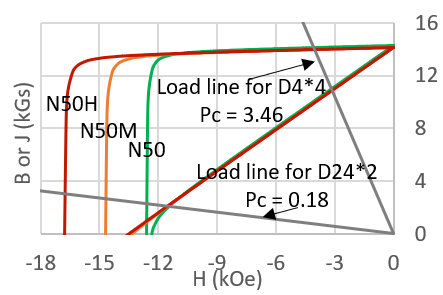
However, experiment shows that when two permanent magnets with significantly different permeance coefficients (Pc) — say, a small one with dimensions of D4 mm × 4 mm and Pc of 3.46, and a big one with dimensions of D24 mm × 2 mm and Pc of 0.18 — are put together with their directions of magnetization (DOM) pointing against each other, instead of repelling, they will attract to each other, especially when the coercivity of the big magnet is relatively low.
This phenomenon may lead people to think that Coulomb’s law for magnetic charges is not always right, and in some cases like poles will attract. In this work, we show that the above bizarre phenomenon is caused by the partial demagnetization in the low-Pc magnet, rather than violation of Coulomb’s law. The working point for the stand-alone low-Pc (N50 grade) magnet is very near the knee of its demagnetizing curve, so it’s very vulnerable to the external and self-demagnetizing field.
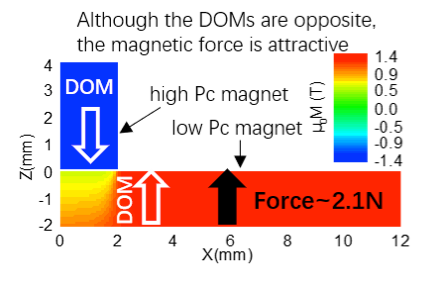
Finite Element Analysis (FEA) shows that demagnetization happens obviously in the central region of the magnet with low Pc, but the magnetization remains in the same direction all over the magnet. FEA also gives an attractive force when the above low-Pc and high-Pc magnets are close to each other and with opposite directions of magnetization (DOMs). Based on the magnetic charge model and Coulomb’s law, the numerical integration of Coulomb’s force is carried out, which gives almost the same attractive force as FEA.
References
[1] J. M. D. Coey, Magnetism and Magnetic Materials, 2010, Cambridge University Press, p. 45.
[2] Soshin Chikazumi, Physics of Ferromagnetism, second edition, 1997, Oxford University Press, p. 3.